A musty smell in house air is usually not coming from anywhere inside the house. People spend weeks hunting it room by room, replacing carpet, scrubbing bathrooms, and running fans, and the smell keeps coming back because the source is under the floor. Before you spend anything, though, rule out the handful of things that really are inside. Some of them take ten minutes and cost nothing.
Rule Out the Five Places Everyone Checks First
Walk the house first. We would rather you find a dried-out drain trap than pay us to tell you about one.
- A rarely used sink, shower, or floor drain. The P-trap holds water that blocks sewer gas. In a guest bath nobody uses, that water evaporates in a few weeks. Run the tap for thirty seconds. Free.
- The washing machine gasket and drain pan. Pull back the rubber door gasket on a front loader and look in the folds. Wipe it out and leave the door open between loads. Free.
- The refrigerator drip pan. Slide the fridge out and check the shallow pan underneath. It collects condensate and, over years, a film that smells. Rinse it. Free.
- Damp carpet or padding along an exterior wall. Press a paper towel into the carpet in the corners of ground-floor rooms. Wet padding smells even when the surface feels dry, and it usually points at a foundation or gutter issue outside.
- The HVAC condensate pan and filter. A clogged drain line lets water sit in the pan and grow a biofilm. Change the filter and have the drain line cleared. Low cost, and worth doing regardless in August.
If the smell survives all five checks, and it gets stronger on humid mornings, stop looking at eye level.
Why a Musty Smell in House Air Rises From the Crawl Space
Your house is a chimney. Warm air escapes through the upper part of the building, and that escaping air has to be replaced, so the house pulls in air from the lowest opening it has. In northeast Georgia, that is almost always the crawl space. Building science calls it the stack effect, and the plain version is this: air moves up through your house all day long, and it starts underneath you.
The air under your floor does not stay under your floor. If the crawl space smells, the house smells. There is no filter between the two.
The tells that point downward:
- The odor is strongest near floor registers, in ground-floor closets, and along baseboards
- It is worse first thing in the morning
- It is worse after humid stretches and during rainy weeks
- It fades when the house is opened up and comes back when it is closed
- It is strongest in the oldest, lowest part of the house
Why Air Fresheners and Ozone Machines Never Hold
You are not deodorizing a room. You are deodorizing an air supply that refreshes itself continuously, all day, every day.
That is why the smell comes back. Nothing about the source changed. You bought a few hours.
Chasing a musty smell you cannot find? Book a free inspection and we will get under the house and look. The crawl space inspection is free, with no pressure.
What That Smell Actually Is
The musty odor is a byproduct, not the growth itself. Fungal growth releases microbial volatile organic compounds as it feeds on damp wood, the paper facing on insulation, and settled dust. Those gases are what your nose is picking up, and they travel on air far more easily than spores do.
Common sources under a Georgia house:
- Growth on floor joists and the underside of the subfloor
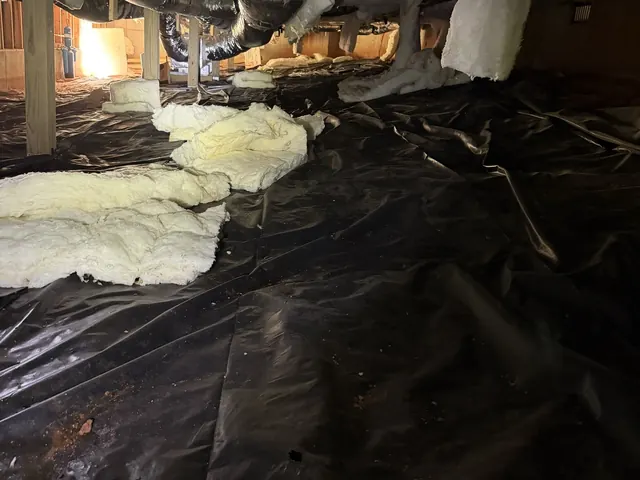
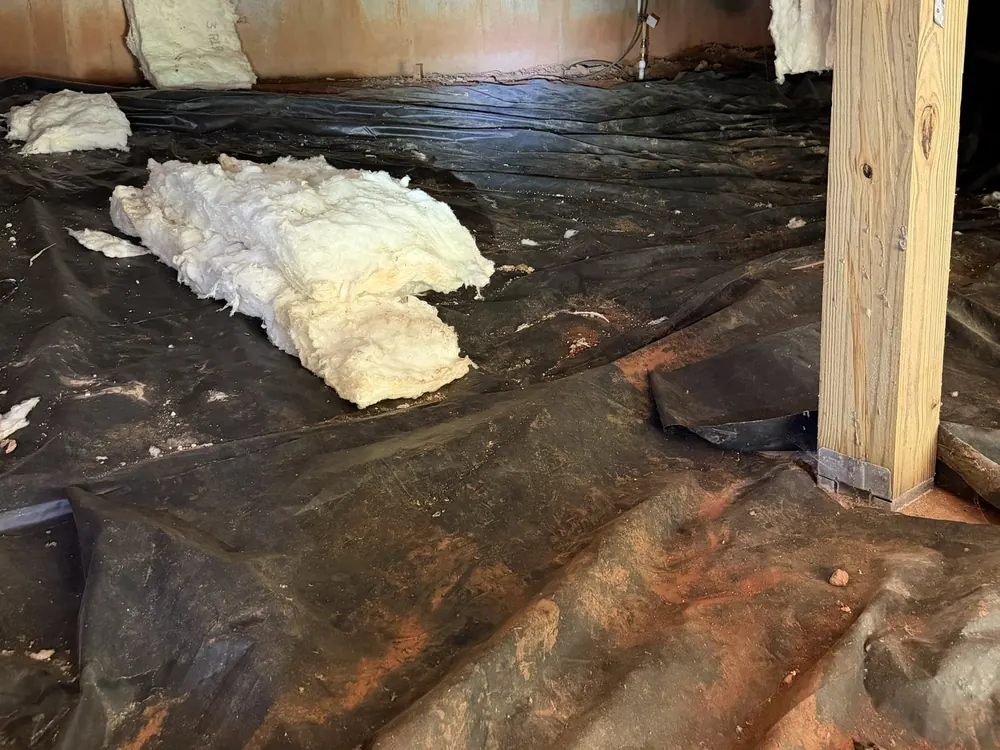
- Fiberglass insulation that has soaked up moisture and is sagging or on the ground
- An exposed dirt floor evaporating moisture upward day and night
- Standing water left after a storm
- Decaying debris, old cardboard, or rodent activity
Northeast Georgia sees this so consistently for a reason. We live in a humid subtropical climate where summer dew points sit above crawl space surface temperatures, so outside air entering through open foundation vents gives up its water on your framing. The wood stays damp, and damp wood in the dark is exactly what fungal growth wants.
Here is the honest version. A musty smell is a moisture symptom. It tells you water is winning somewhere under your house. It does not by itself tell you how bad it is or how long it has been going.
How to Get Rid of the Odor at the Source Instead of Covering It
The sequence matters more than any single product. Stop the water, remove what is contaminated, seal the space, then control humidity. Skip a step and the smell comes back on schedule.
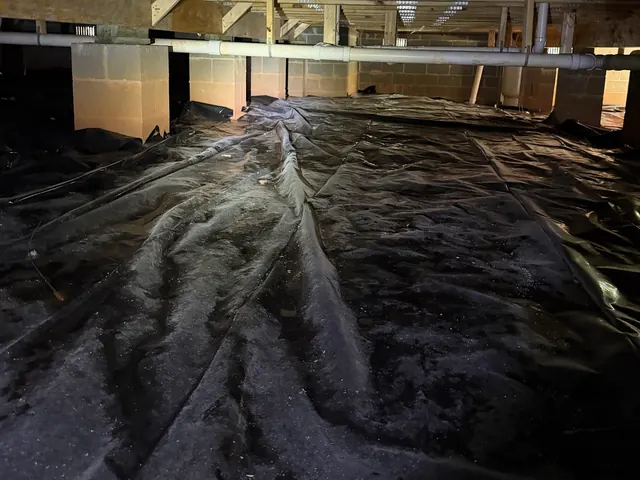
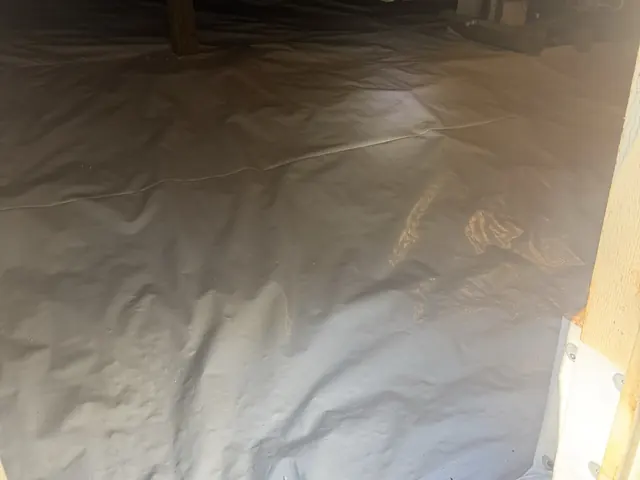
In practice, that means grading and drainage corrections where water is entering, removal of soaked insulation and debris, treatment of the affected wood, a heavy liner sealed across the floor and up the foundation walls, sealed vents and band joist, and a dehumidifier sized to the actual cubic footage.
What does not work on its own:
- Fogging or ozone treatments
- A dehumidifier running in an unsealed, vented crawl space
- Loose plastic laid over the dirt
- Anything applied to the growth without addressing where the water came from
Every one of those manages a symptom. The smell returns because the conditions never changed.
Scope, honestly: the cost depends on the size of the space and its condition, and nobody can price it from the driveway. A free inspection gets you the real number, and every install carries our 5-year warranty: we cover the unit and the install. Some houses need drainage and nothing else. If that is your house, we will tell you that, and you can spend the difference somewhere it matters.
We are owner-operated and family-run, founded in 2024. No franchise, no pressure.
Frequently Asked Questions
Q: Can a musty smell in the house make you sick?
A: Some people report headaches, congestion, throat irritation, or worsened allergy symptoms in damp buildings, and others notice nothing at all. We are a crawl space company, not doctors, so health questions belong with your physician. What we can tell you is that the smell means moisture, and moisture is fixable.
Q: Why does my house smell musty only in the summer?
A: Summer is when outside dew points climb above the temperature of the surfaces under your house. Humid air enters through open foundation vents, condenses on cool joists and ductwork, and keeps the wood damp. In an Athens August, that runs every day.
Q: Will an air purifier get rid of a musty smell?
A: No. A purifier filters the air already in the room while the crawl space keeps supplying more. Carbon filters can knock the odor down temporarily, but you are treating the air, not the source that is producing it.
Q: How do I tell mold from mildew under my house?
A: For a homeowner, the distinction rarely changes the plan. Both need moisture, both feed on organic material, and both go away for good only when the crawl space dries out. What matters more is the moisture reading in the wood, not the label on the growth.
Q: Does crawl space encapsulation get rid of the musty smell?
A: Usually yes, when the encapsulation is done in the right order. Removing the contaminated material and sealing the space cuts off both the odor source and the moisture feeding it, and the dehumidifier keeps it from starting again. Sealing over a wet, uncleaned crawl space does not.
Find the Source, Not a Cover-Up
If a musty smell survived your walkthrough of the house, the answer is under the floor, and finding out costs you nothing. Crawl Space Doctors gives you a free crawl space inspection and an honest answer even if the answer is that nothing needs doing. Book a free inspection. We serve Athens, Madison, Monroe, Watkinsville, Gainesville, Augusta, Elberton, and Hartwell.